

Worship Aware
Worship Aware
The Ultimate Worship Team Resource

Chad Wiebe

Good to meet you, I'm Chad: just a normal dude with dreams, struggles, relationships, way too much work and not enough time...just like everyone else. I could say that I've been involved in worship for nearly 30 years, or that I've studied at two music universities, or that I've written music since I was 18. But this doesn't describe who I am as a relational being, which is often more important than one's accomplishments. Studying Worship Aware brings understanding that relational qualities are often what make worship truly excellent. So who am I, relationally?
I desire to see people connect with God in worship that goes deeper than the music itself, while also making music enjoyable, inspiring, and technically excellent. I love inspiring people to be the best versions of themselves, helping them see that they are capable of more than they know. Encouraging others is one of my favourite activities in life, and I would love to celebrate your worship-team victories with you. The world desperately needs encouragement, and I do it as often as I can.

My journey started at 12 years old, drumming for youth group then moving to the main-room less than a year later. The drums will always be my first and primary instrument, and I love every moment I get to play them, live or in the studio.
My worship experience includes both acoustic and electronic kits, both excellent and brutal examples of both. Nothing teaches a musician more about dynamic control more than an acoustic kit in a small room. Also: nothing teaches a musician more about attitude than playing a terrible electric kit. Playing drums in church from my youth, with all their complexities, has shaped my approach to literally every aspect of worship, regardless of the role I play. And I am grateful for every Sunday I got to spend learning and growing with the drums as my primary instrument.

Yes, I actually used turntables and drum-machines in worship. If there's anything I love in worship (besides seeing people worshipping God) it is pushing the boundaries of what is acceptable and enjoyable during worship. I enjoy doing what hasn't been done, what isn't considered "normal" in worship music. When playing keys, I don't just play piano sounds. I find ways to incorporate all kinds of creative sounds. And I'm still the only one I've ever met who has appropriately integrated turntablism into Sunday-morning worship, enjoyed even by the old people!
The goal is not to make worship a "performance" (how vigorous those conversations get...) but to access the creative DNA of God in music. As God is creative, so we are creative in his image. Therefore I've never been afraid to push boundaries in church music, so long as humility and a "team first" attitude temper the advancement of Christian music.

My favourite worship role is standing behind a mixing board, blending all elements into one sound. No single role teaches you more about music production on a worship team, or teaches you more about worship-team relationship. The sound-tech interacts with each stage-member in different ways: each role requires different technical expectations that influence relational factors. I am grateful for the time spent mixing live-worship, both analog and digital, for I have learned more about relationship in this technical role than in any other.
Worship Aware began as a technical manual for sound-techs, until I realized how much relationship influences technical factors. Then it became a relational manual with technical aspects. Mixing has taught me just how integrated technical and relational disciplines really are in worship.
Photo credit: Jessica Penner
Photo credit: Dona Van Raamsdonk
Photo credit: Nathan White
In the age of A.I. when everyone can be an "expert" - even when they're not - just by typing a few sentences and prompting expertise, it is important to me that people know what I've learned to get to this point, and why Worship Aware should be taken seriously as an informational work. Besides the nearly 30 years of practical worship-team experience in various roles, I actually went to school and studied music. You can't prompt these certificates into existence. I actually had to earn them.

From September 1998 to April of 2000, I studied music at Grant MacEwan. Starting as a performance major on drums, I finished with a Recording Arts Major. This is where my inner fire for music technology was truly fanned, and I began my journey into more "serious" ambitions. Along with recording and music production, I also learned music theory, ear-training, music arranging and some musical history. All of this information helped me to write and produce creative and technically solid material, mixed with excellence with Recording Arts knowledge.
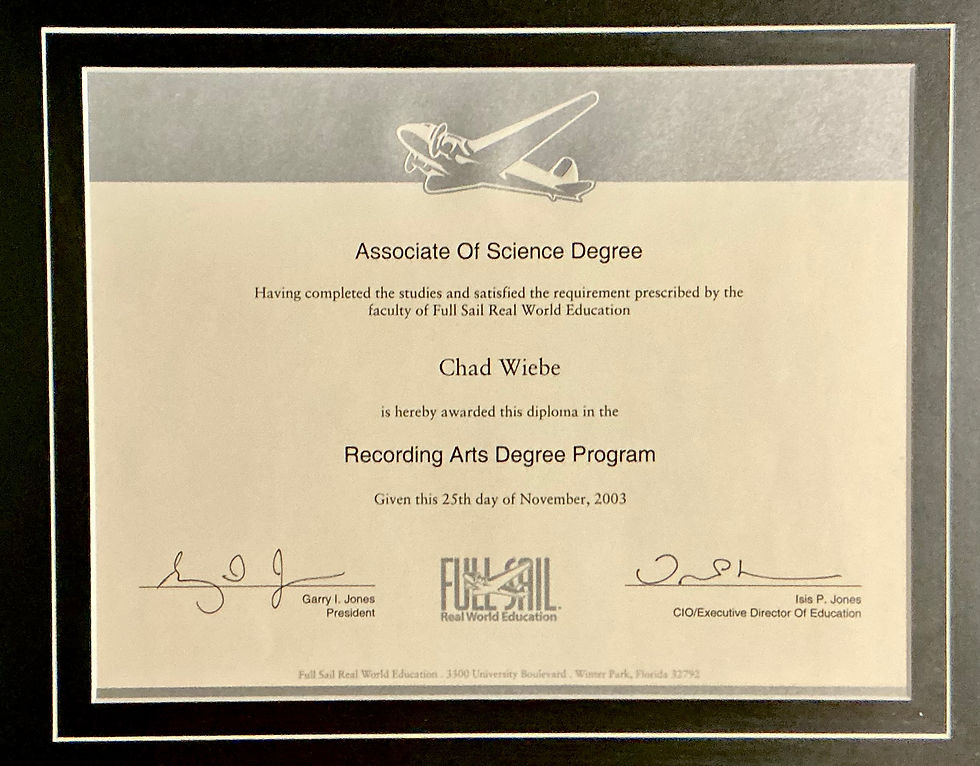
From November 2002 until November 2003, I endured a 12 month intensive audio program at Full Sail in Orlando Florida, receiving an Associate of Science Degree. During this time, I studied live-mixing, studio sessions, sound design and post-production for movies, console studies, MIDI, sound processing, DAWs (digital audio workstations), plus music history and music business. Classes and labs were held in four-hour blocks around the clock. The industry standard large-format consoles at the time were the SSL 9000J and the Amek 9098i.
